Southern Care Lawn & Landscape, Inc. provides outdoor landscape lighting for commercial properties in Buford, Georgia, including entrances, walkways, building facades, trees, and planting beds. It is for property owners and managers whose grounds look good at noon but fade into shadow once the sun goes down. To get started, call or send a request and we will talk through your property, what you want lit, and the next step.
Maybe your entrance disappears at dusk, a walkway feels uneven in the dark, or the plantings you pay to maintain are invisible to anyone arriving after work. Maybe a few old fixtures have failed and the rest are leaning, buried in mulch, or lighting nothing in particular. We start with a walk through the property after dark logic: where people arrive, where they walk, and what deserves to be seen.
Signs your lighting needs work
Most lighting problems are easy to spot once you look at the property at night instead of during a daytime site visit. Here is what property managers commonly notice:
- Dark patches along walkways, steps, or curbs where visitors slow down or look uncertain
- A building entrance or sign that is hard to find after sunset
- Fixtures that have shifted, tilted, or sunk into mulch and now aim at the sky or a wall
- Burned out or flickering lights that nobody has replaced
- Bright glare in one spot and total darkness a few feet away
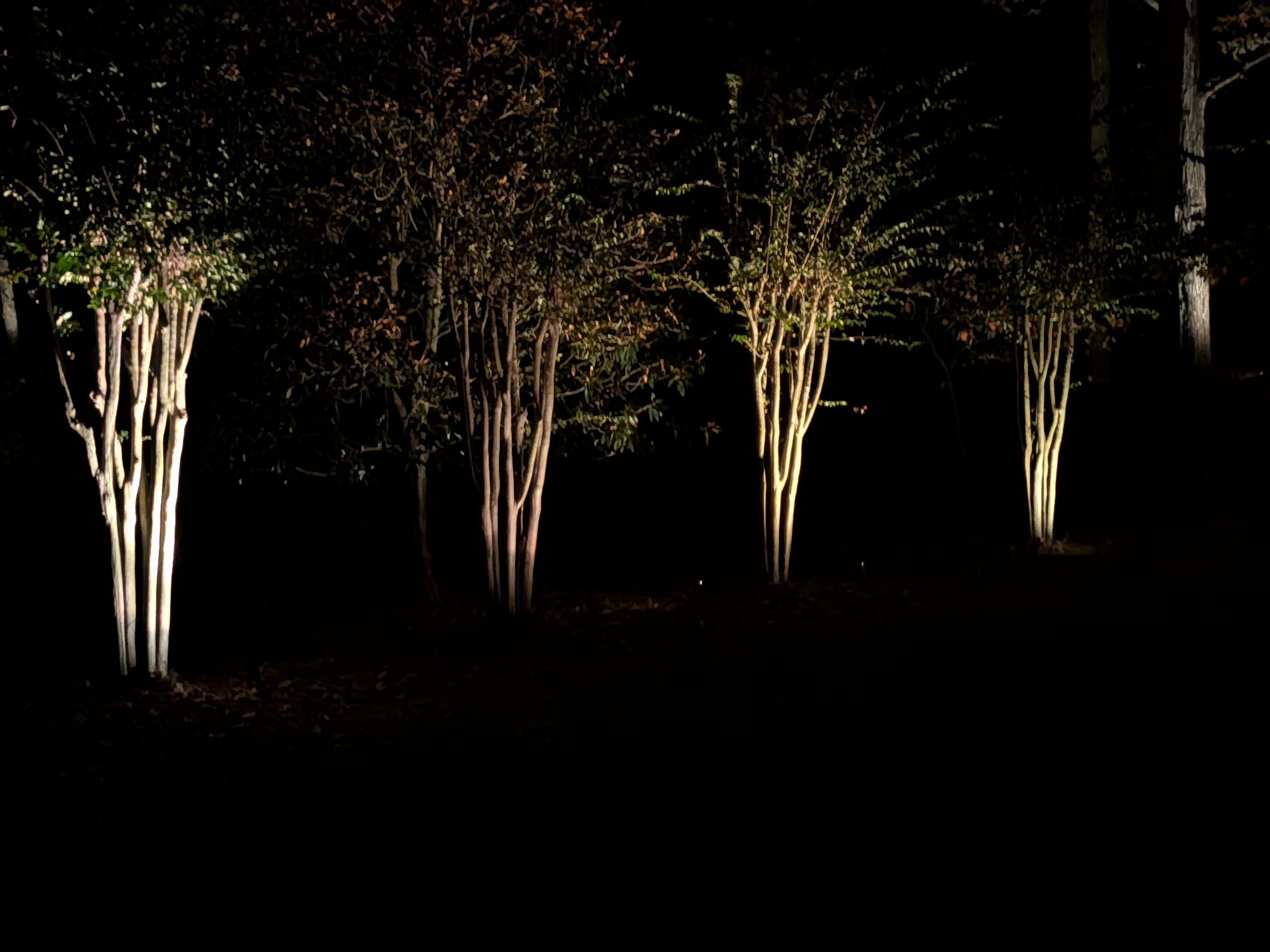
- Mature trees and landscape beds that disappear completely at night
If two or three of these sound familiar, the property is a good candidate for new lighting or a layout rework.
What lighting covers
Outdoor landscape lighting is about placing light where it improves how a property looks and how people move through it. For commercial grounds, that usually comes down to a few common jobs.
Entrances and walkways
Path lights, step lights, and low-level fixtures guide people from the parking area to the door. The goal is even, comfortable light without harsh glare in anyone's eyes.
Trees, beds, and building features
Uplighting a mature tree, washing light across a stone wall, or highlighting a sign and planting bed gives the property presence at night. It also makes the landscaping investment visible for more hours of the day.
Lighting versus other work
Property managers sometimes mix up landscape lighting with larger electrical work. Landscape lighting is the decorative and wayfinding layer that sits within your beds, along your walks, and around your plantings. Tall parking lot poles, building-mounted security fixtures, and electrical panel upgrades are generally a different type of job. This page covers landscape lighting only. If you are not sure where your project falls, ask us and we will tell you which part we can handle and which part is a separate service.
How the job goes
A lighting project normally follows a clear order, and knowing it helps you plan around it.
- Walk the property. We look at the buildings, entrances, walks, trees, and beds, and talk about how people use the site at night.
- Decide what to light. Not everything needs a fixture. The plan picks priorities: safe paths first, then focal points like signage, specimen trees, and facade features.
- Review the quote. You see the scope in writing before any work begins, including fixture locations and any related work around them.
- Install and adjust. Fixtures are set, aimed, and connected, with attention to existing beds, turf, and irrigation lines so nothing gets damaged.
- Check after dark. Lighting should be reviewed at night, since that is the only time you can see whether the aim, spacing, and brightness are right.
Buford site conditions
Buford sits in the Georgia Piedmont, where soils are typically heavy red clay and summers are hot and humid. Both matter for lighting. Clay can be hard to dig and holds water after storms, so fixture placement and wire routing deserve some thought. Fast-growing plants and seasonal color changes can also cover or redirect a fixture within a single season, so lighting should be set with mature plant size in mind. Shorter winter days mean many commercial properties run their lights well before closing time, which makes good coverage more important from late fall through early spring.
Signs of quality work
Whoever you hire, here are practical standards you can use to judge the result:
- Light, not glare. You should see the path, the tree, or the wall, not a bright bulb. Fixtures should be shielded or aimed so they do not shine into windows or drivers' eyes.
- Even coverage. Walkways should not alternate between bright pools and dark gaps.
- Neat wiring. Cables should be buried or concealed, with no loose runs across beds or turf.
- Aimed at night. Final adjustments should happen after dark, not guessed at in daylight.
- Clean finish. Mulch, soil, and turf should be restored around every fixture, with no leftover debris.
What affects cost
Lighting costs vary because no two properties are alike. The main factors are:
- The number of fixtures and how much area you want covered
- The type of fixtures, such as path lights, uplights, or step lights
- Distance from the power source and the length of wire runs
- Ground conditions, including clay, rock, roots, and hardscape that must be worked around
- Access to the site and the amount of existing landscaping around fixture locations
- Whether you are adding new lighting or reworking and replacing existing fixtures
A clear written quote should spell out the scope and fixture locations, what is included in setup and adjustment, any extras you may choose to add, and how changes are handled if you expand or shrink the plan midstream. If a quote is vague on any of those, ask for it to be itemized.
Questions to ask first
Before you hire anyone for outdoor lighting around Buford, ask these:
- Do any permits or licenses apply to this work, and who handles them? Requirements can depend on how the lighting is powered and connected.
- Are you insured for work on commercial property? Ask for proof if the answer is yes.
- Exactly what is included in the quote? Fixtures, wiring, installation, aiming, and cleanup should all be named.
- How will you protect existing landscaping and irrigation? Digging near beds, turf, and sprinkler lines can cause damage.
- When will the work happen, and how will you keep me updated? You should know the schedule and who your contact is.
- Will you review the lighting with me at night? Adjustments are easiest to judge after dark.
Common questions
How do I get started with landscape lighting for my property?
Call or send a request through the site. We will talk about the property, what you want lit, and set up a time to look at the grounds so a plan and written quote can follow.
When is the best time of year to install lighting around Buford?
Lighting can generally be added through most of the year in north Georgia. Many managers plan it for fall or early spring, before the days get short or the busy growing season starts, but the right timing depends on your property and schedule.
How is the price for outdoor lighting worked out?
It comes down to the number and type of fixtures, how far wire needs to run, ground and access conditions, and how much existing landscaping has to be worked around. A written quote should break these out clearly.
Can you add lighting to a landscape that is already installed?
Yes, lighting is often added to established properties. The work is planned around existing beds, turf, and irrigation so disruption stays limited.
How often should lighting be checked or adjusted?
It is worth a look at night a couple of times a year and after major planting changes. Growing shrubs and shifting soil can cover or redirect fixtures over time.
Will lights make my property look better or just brighter?
Good lighting is selective. The goal is to show off the entrance, trees, and key features while keeping walkways comfortable to use, not to flood everything with the same level of light.